How do tree roots get into sewer pipes?
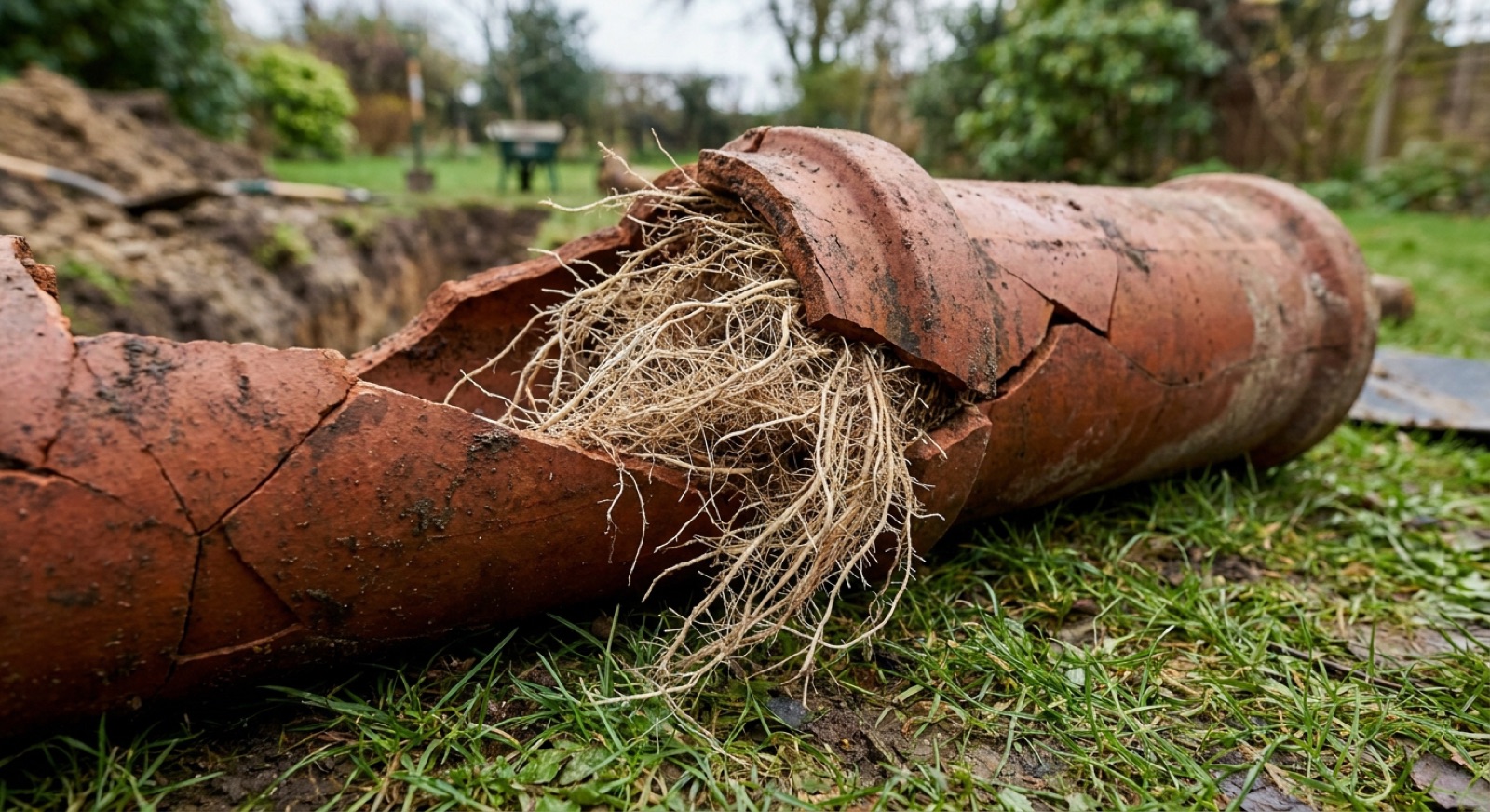
They don't break in — they're invited. Sewer pipes leak microscopic amounts of warm, nutrient-rich moisture at ageing joints, and roots follow that moisture. Fine root hairs slip into a joint or hairline crack, then thicken, wedge the opening wider, and branch into a net that catches everything the pipe carries.
Sydney's problem is specific: most homes built before the 1980s have earthenware (clay) sewer pipes, laid in short segments with a joint every 600mm or so. Every joint is a potential doorway, the mortar or rubber sealing them has had 50–100 years to degrade, and the street trees planted alongside them have had just as long to explore. It's not bad luck — it's a design meeting its life expectancy.
The tell-tale signs
- Blockages that keep returning — cleared, fine for months, blocked again
- Worst after dry spells (roots chase moisture hardest in drought)
- Gurgling toilets and slow drains through the whole house
- One suspiciously lush, green strip of lawn along the sewer run
That recurrence pattern is the signature. Hair or grease blockages don't come back on a schedule; roots do, because clearing them doesn't close the door they came through.
What kills tree roots in sewer pipes?
Cutting and high-pressure jetting remove them; foaming herbicides and copper sulphate kill root tissue. All of it is temporary — regrowth through the same openings typically takes 6–24 months. Permanent fixes close the entry points instead: jointless relining or replacing the damaged run.
Ranked honestly:
- Electric root cutting — pokes a hole through the mass so water flows. Cheapest, shortest-lived; the cut roots regrow denser, like pruning.
- High-pressure water jetting — shears roots off at the pipe wall and cleans the full bore. Better clear, same catch: the joint is still open. This is what we do as standard on root blockages.
- Chemical root treatment — foaming herbicide slows regrowth to buy time; copper sulphate is cruder and rough on soil and waterways. A deferral, not a fix.
- Pipe relining — after jetting, a resin liner cures inside the pipe: continuous, jointless, nothing for a root to enter. Lifetime warranty, no digging. This is the "stop paying every 18 months" option — see how relining works.
- Excavate and replace — for pipes too collapsed to reline. PVC with solvent-welded joints is root-resistant; the digging is the cost.
How much does it cost to fix?
Clearing roots by jetting: usually $300–$500. Permanently fixing the pipe: a single-joint patch reline roughly $500–$2,500; full-length relining commonly $3,000–$15,000. The arithmetic favours fixing: three or four root clears plus one overflow cleanup exceeds many patch repairs.
Full pricing context in the Sydney price guide. The CCTV footage from your first clear tells us exactly how many joints are compromised — sometimes it's one patch, not a whole reline.
Should I just remove the tree?
Usually not. Mature tree removal costs thousands, often needs council approval (many Sydney councils protect established trees), and the root mass already in your pipe keeps growing for years after the tree dies. Fix the pipe; keep the tree.
And if it's the neighbour's tree or a council street tree — you still own the pipe problem, unfortunately. The responsibility rules are covered in who's responsible for a blocked sewer.
Can I prevent roots getting in?
- Know your pipes: a one-off CCTV inspection maps material, joints and existing intrusion — especially worth it when buying an older home.
- Plant smart: keep thirsty species (willows, figs, poplars, camphor laurels) well away from the sewer run.
- Act on the first blockage: the first root intrusion is the cheapest one to fix permanently — one patch instead of a full reline five years later.